
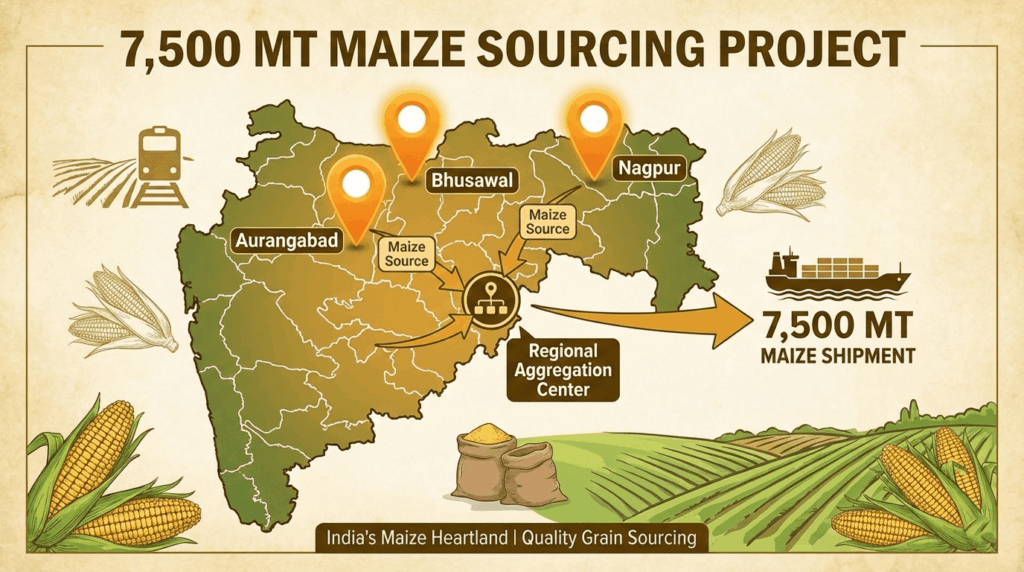
On paper, maize looks like a straightforward agricultural commodity. In reality, moving it at scale across different sourcing regions and under export timelines requires far more attention than most people expect. US Enterprises managed the movement of 7,500 metric tons of maize sourced from Nagpur, Aurangabad, and Bhusawal, coordinating sea freight shipments for multiple clients under a single, controlled logistics framework.
This was not a one-point pickup or a one-client operation. It involved synchronising supplies from different regions, maintaining cargo quality, and ensuring smooth port movement all while keeping schedules intact.
The shipment was executed for multiple agricultural traders and buyers, each operating on tight delivery commitments. While volumes varied by client, expectations were consistent: timely dispatch, clean documentation, and cargo delivered in good condition.
US Enterprises was chosen to bring structure to this complexity and manage the entire movement without creating delays or confusion between stakeholders.
Maize was dispatched from three different regions, each with its own loading readiness, storage conditions, and dispatch timelines. Aligning these flows without causing congestion was a key challenge.
Maize is highly sensitive to moisture and contamination. Improper handling or extended exposure can quickly affect quality and acceptance at destination.
Though the total volume was 7,500 MT, shipments were split across clients and sailings. Planning vessel space efficiently was critical to avoid cost overruns and delays.
Agricultural exports demand accurate documentation, inspections, and coordination with port authorities. Any mismatch could slow down clearance.
We planned dispatch schedules individually for Nagpur, Aurangabad, and Bhusawal, ensuring steady cargo flow without overwhelming storage or port facilities.
Maize was staged carefully at the port to minimize dwell time and reduce exposure to environmental risks.
Vessel schedules were selected to match cargo readiness, allowing smooth movement without rushed loading or last-minute changes.
Our team completed export paperwork and inspection coordination early, ensuring that cargo moved through customs without interruption.
Handling during loading was closely monitored to protect cargo condition and avoid spillage or damage.
Phase 1: Source coordination and cargo readiness
Phase 2: Documentation and inspection alignment
Phase 3: Port handling and sea freight loading
Phase 4: Shipment dispatch and delivery confirmation
Each phase was connected, ensuring continuity across the supply chain.
Total Cargo Moved: 7,500 MT of maize
Source Locations: Nagpur, Aurangabad, Bhusawal
Clients Served: Multiple
Cargo Quality Issues: None reported
Clearance Delays: Zero
Schedule Adherence: Fully maintained
The shipments moved smoothly from source to vessel, meeting both quality and timing expectations.
This case highlighted US Enterprises’ ability to manage agricultural cargo that involves multiple origins and multiple clients without losing control or consistency.
Maize exports may seem routine, but execution is where success is decided. By moving 7,500 MT of maize from three sourcing regions under a unified logistics plan, US Enterprises showed how planning, care, and experience keep agricultural shipments on track.
For exporters who need reliability across locations, clients, and timelines, US Enterprises delivers logistics that stay grounded from farm gate to freight gate.