
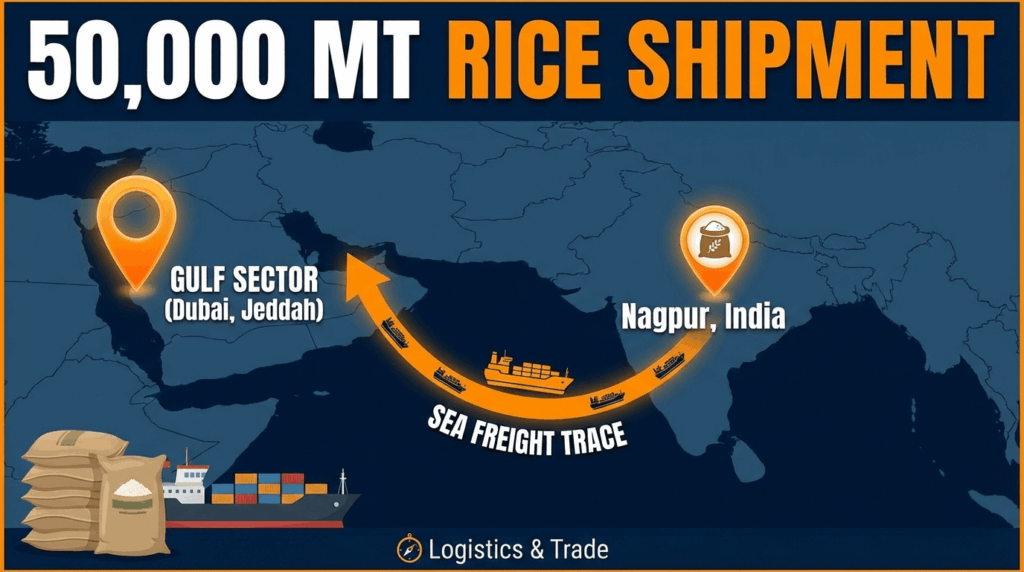
Rice exports look routine only until you’re responsible for moving them at scale. US Enterprises managed the export of 50,000 metric tons of rice from Nagpur to multiple destinations across the Gulf sector, supplying markets where consistency, quality, and timing directly impacted food distribution networks.
This wasn’t a single buyer or a single sailing. It was a continuous flow of agricultural cargo, planned and executed carefully to ensure the rice reached Gulf markets in good condition and within committed timelines.
The shipments were executed for various exporters and trading clients, each catering to different buyers across the Gulf region. While the product was the same, contract terms, delivery windows, and quantity splits varied.
US Enterprises’ role was to act as the common logistics backbone aligning multiple client requirements into one smooth export operation without delays or confusion.
Handling 50,000 MT across different buyers meant precise planning. Any mismatch between cargo readiness and vessel schedules could create congestion or missed sailings.
Rice is sensitive to moisture, handling conditions, and storage time. Poor protection can lead to quality issues, rejection, or loss in market value.
Exports to Gulf markets involve strict documentation, labeling norms, and port clearance procedures. Accuracy was critical to avoid delays at destination ports.
Agricultural exports often operate under narrow shipment windows. Extended port stays increase both cost and quality risk.
Cargo movement from Nagpur was scheduled in phases, ensuring steady flow to the port without overloading storage facilities.
Vessels were selected and scheduled based on cargo readiness and destination requirements, allowing consistent movement across Gulf routes.
Export paperwork, inspections, and compliance checks were completed in advance, reducing clearance time and avoiding last-minute issues.
Our team closely monitored loading and handling to protect rice quality during stuffing and vessel loading
Advance coordination with destination agents helped ensure faster discharge and delivery once shipments reached Gulf ports.
Phase 1: Source planning and cargo readiness
Phase 2: Documentation and inspection alignment
Phase 3: Sea freight execution
Phase 4: Delivery confirmation across Gulf destinations
Each phase overlapped carefully to maintain momentum and control.
Total Cargo Moved: 50,000 MT of rice
Source: Nagpur
Destination: Gulf sector
Transport Mode: Sea freight
Quality Issues: None reported
Clearance Delays: Nil
Delivery Performance: As per schedule
Despite the volume and complexity, shipments moved smoothly from origin to destination.
This case highlighted US Enterprises’ strength in handling large-scale agricultural exports to demanding international markets.
Rice exports are about trust in quality, timing, and execution. By successfully moving 50,000 MT of rice from Nagpur to Gulf markets, US Enterprises proved its ability to manage agricultural logistics at scale without cutting corners.
For exporters supplying food markets where reliability matters most, US Enterprises deliver logistics that keep supply chains steady shipment after shipment.