
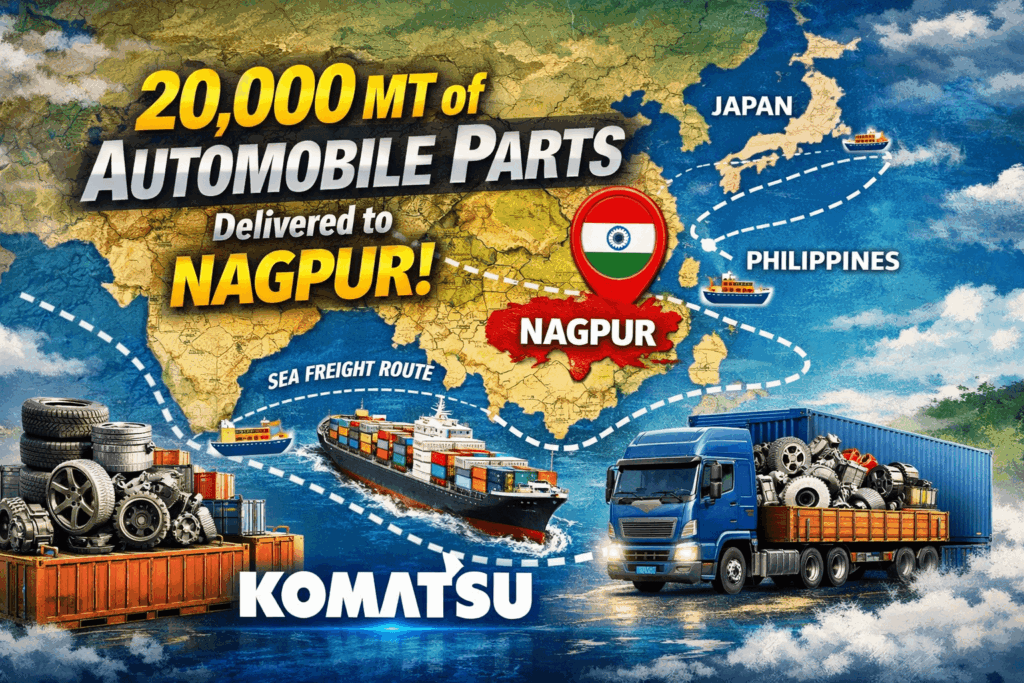
Automobile and heavy machinery parts don’t move like regular cargo. Every component plays a role in keeping production lines running, and even a small delay can slow down operations on the ground. US Enterprises handled the import of 20,000 metric tons of automobile parts for Komatsu, moving cargo from Japan, Singapore, and the Philippines to Nagpur via sea freight.
This was not a single-origin shipment. It was a multi-country supply chain operation where timing, coordination, and accuracy mattered at every step.
Komatsu operates in the heavy machinery space, where uninterrupted availability of parts is critical for assembly, maintenance, and after-sales support. Their imports feed directly into operational planning, leaving little room for uncertainty.
They needed a logistics partner who could manage volume, multiple origins, and strict schedules without disrupting the flow of parts into India.
Coordinating shipments from three different countries meant aligning different export procedures, port operations, and sailing schedules under one plan.
Automobile and machinery parts vary widely in size and weight. Some components required special handling and secure packing to avoid transit damage.
Handling 20,000 MT required phased planning to avoid congestion at ports and ensure steady inland movement toward Nagpur.
Automotive parts are subject to detailed customs scrutiny. Accurate documentation and classification were essential to avoid clearance delays.
We structured shipments country-wise, allowing cargo from Japan, Singapore, and the Philippines to move in planned waves rather than uncoordinated arrivals.
Vessel schedules were aligned with cargo readiness, ensuring smooth sailings without rushed loading or missed connections.
Import documentation, part details, and customs requirements were verified well before vessel arrival, reducing clearance risk.
Cargo discharge was supervised closely to prevent handling damage, especially for heavy and sensitive components.
Once cleared, parts were moved efficiently to Nagpur, minimizing port dwell time and keeping Komatsu’s supply chain on track.
Phase 1: Origin coordination and shipment planning
Phase 2: Sea freight execution from multiple countries
Phase 3: Port discharge and customs clearance
Phase 4: Inland transport and delivery to Nagpur
Each phase was managed with continuity to avoid gaps in supply.
Total Cargo Moved: 20,000 MT
Origins Covered: Japan, Singapore, Philippines
Destination: Nagpur
Transport Mode: Sea freight
Cargo Damage: None reported
Clearance Delays: Nil
Delivery Performance: As scheduled
The imports reached Nagpur smoothly, supporting uninterrupted operations.
This case reinforced US Enterprises’ ability to handle complex automotive and heavy machinery logistics.
Automobile and machinery parts logistics is about keeping momentum alive. By successfully importing 20,000 MT of automobile parts from three countries into Nagpur, US Enterprises proved its ability to manage scale, complexity, and precision together.
For manufacturers who depend on steady parts flow and predictable timelines, US Enterprises delivers logistics that keep operations moving without slowdown or surprise.