
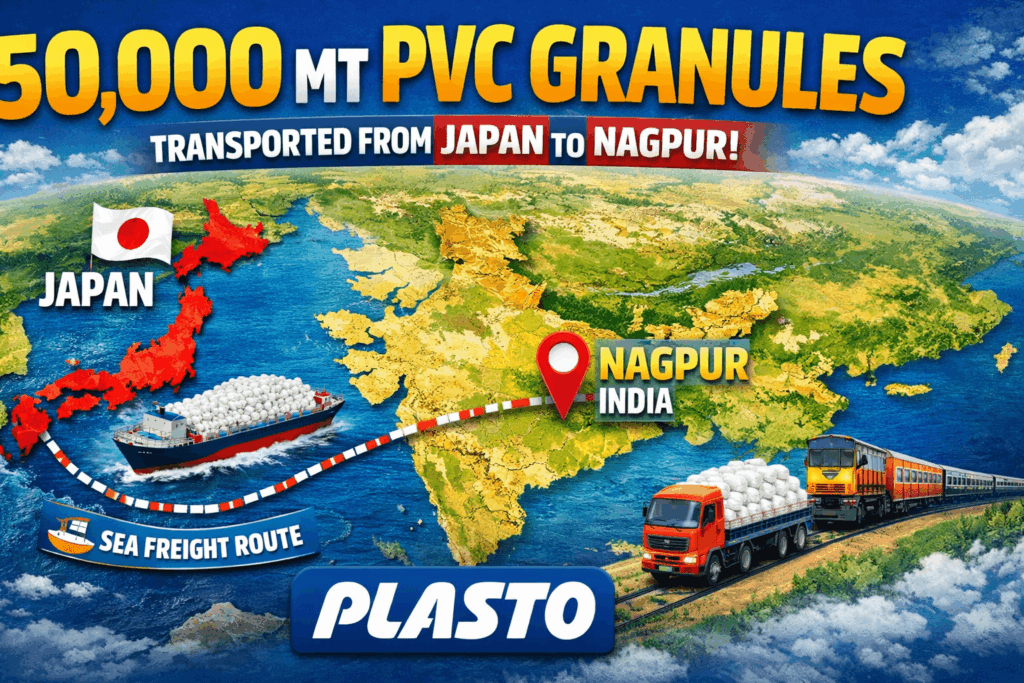
Petrochemical logistics demands discipline. Products may look uniform, but the movement behind them is anything but simple. US Enterprises managed the large-scale import of 50,000 metric tons of PVC granules from Japan to Nagpur using sea freight, a project that required consistency, planning, and absolute control over timelines and quality.
PVC granules are the backbone of many manufacturing processes. Any delay or contamination can disrupt production schedules and inventory planning. Our role was to make sure the material arrived exactly as expected, clean, on time, and ready for use.
Plasto is a growing industrial player that depends on steady and predictable raw material imports to keep its manufacturing operations running smoothly. For them, logistics is directly linked to plant efficiency.
They needed a logistics partner who could manage high-volume imports without surprising someone who understands that reliability matters just as much as cost.
Handling 50,000 MT required phased shipment planning. Managing vessel space, discharge schedules, and inland movement had to be done without creating bottlenecks.
PVC granules must be protected from moisture and contamination. Improper handling during transit or discharge could compromise material quality.
Imports from Japan involve strict documentation, customs procedures, and quality checks. Any mismatch could delay clearance and impact plant supply.
Once cargo landed, smooth movement to Nagpur was critical to avoid port congestion and storage delays.
The total volume was divided into well-planned consignments, ensuring steady inflow rather than sudden inventory overload.
We worked closely with shipping lines to align sailing schedules with manufacturing demand, keeping supply consistent.
Import paperwork, certifications, and customs documentation were prepared and verified in advance to ensure smooth clearance.
Cargo discharge was monitored closely to prevent spillage, moisture exposure, or handling damage.
Once cleared, cargo was moved promptly to Nagpur, minimizing dwell time at port and ensuring timely availability for production.
Phase 1: Import planning and shipment scheduling
Phase 2: Sea freight execution from Japan
Phase 3: Port discharge and customs clearance
Phase 4: Inland transport and delivery to Nagpur
Each phase was connected to keep material flowing without interruption.
Total Cargo Moved: 50,000 MT of PVC granules
Route Covered: Japan to Nagpur
Transport Mode: Sea freight
Quality Issues: None reported
Clearance Delays: Zero
Supply Disruptions: None
The material reached the plant as planned, supporting uninterrupted manufacturing operations.
This case reinforced US Enterprises’ capability in managing bulk petrochemical imports with consistency and care.
Bulk imports aren’t just about moving volume, they’re about keeping factories running. By successfully importing 50,000 MT of PVC granules from Japan to Nagpur, US Enterprises proved its ability to manage scale without losing control.
For manufacturers who depend on steady raw material flow, US Enterprises delivers logistics that work quietly in the background so production never has to stop.