
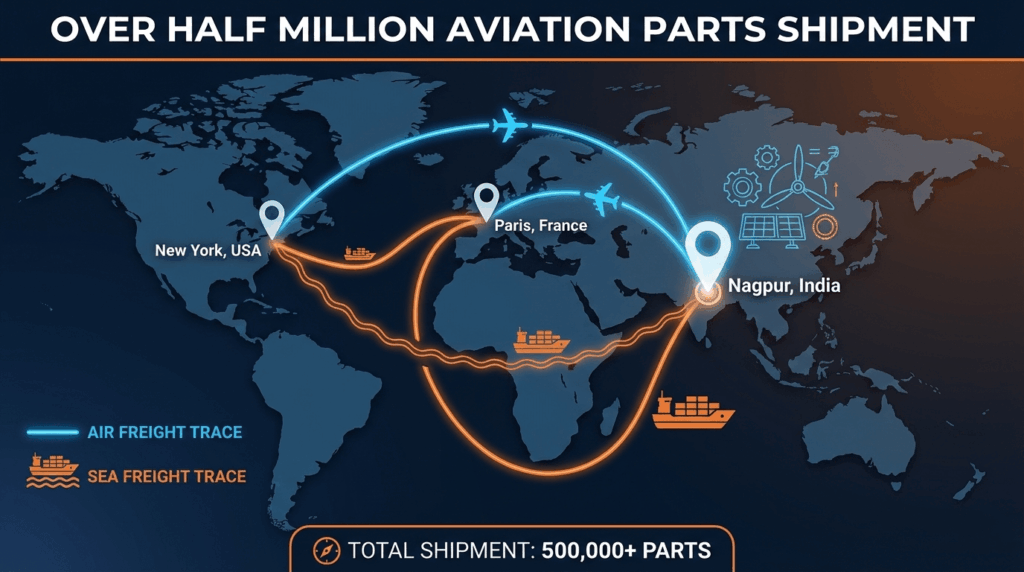
Aviation logistics is a different world altogether. There is no room for delay, no tolerance for error, and absolutely no compromise on compliance. US Enterprises was entrusted with handling over half a million shipments of aviation parts originating from Nagpur and moving to France and the United States using a combination of air and sea freight.
This was not a one-time movement or a single project window. It was a continuous, high-frequency logistics operation where consistency mattered just as much as speed. Every shipment carried responsibility not just of value, but of safety and operational continuity in aviation manufacturing.
The shipments were handled for TASL and DRAL, organizations deeply involved in the aerospace and aviation ecosystem. Their supply chains depend on precision-timed deliveries, strict traceability, and flawless documentation.
For them, logistics was not a support function. It was a critical extension of their production line.
Managing over half a million shipments meant dealing with daily dispatches, varied part sizes, and constant coordination between teams, carriers, and destinations.
Some components required urgent air freight due to production timelines, while others moved via sea freight for cost efficiency. Balancing speed and cost without losing control was a constant challenge.
Aviation parts demand precise documentation, part traceability, and adherence to international aerospace standards. Even a minor mismatch could delay shipments or disrupt manufacturing schedules.
Any delay had the potential to slow assembly lines or affect downstream operations in France and the US.
We classified shipments based on urgency, size, and destination, assigning the right transport mode air or sea for each movement.
A specialized aviation logistics team managed coordination between warehouses, airlines, shipping lines, and customs authorities, ensuring continuity across shipments.
Every shipment was backed by accurate paperwork, part identification, and compliance checks, prepared well in advance to avoid clearance issues.
Frequent communication with stakeholders ensured visibility and quick decision-making whenever priorities shifted.
Our processes were built to handle volume. Whether it was 100 shipments a week or several thousand, execution remained consistent.
Phase 1: Shipment classification and mode selection
Phase 2: Packaging, labeling, and documentation
Phase 3: Air and sea freight execution
Phase 4: Delivery confirmation and performance tracking
Each phase ran continuously, supporting long-term operational flow rather than a single delivery milestone.
Total Shipments Handled: 500,000+
Origin: Nagpur
Destinations: France and the United States
Transport Modes: Air & Sea
Compliance Issues: None reported
Delivery Reliability: Consistently on schedule
The operation ran smoothly across months, supporting uninterrupted aviation supply chains.
This case study reinforced US Enterprises’ capability in handling complex, high-volume aviation logistics.
Aviation logistics is built on trust, precision, and consistency. By successfully managing over half a million aviation part shipments to France and the US, US Enterprises proved its ability to operate at scale without losing attention to detail.
For aviation and aerospace companies that need a logistics partner who understands pressure, volume, and precision, US Enterprises delivers shipment after shipment, without missing a beat.