
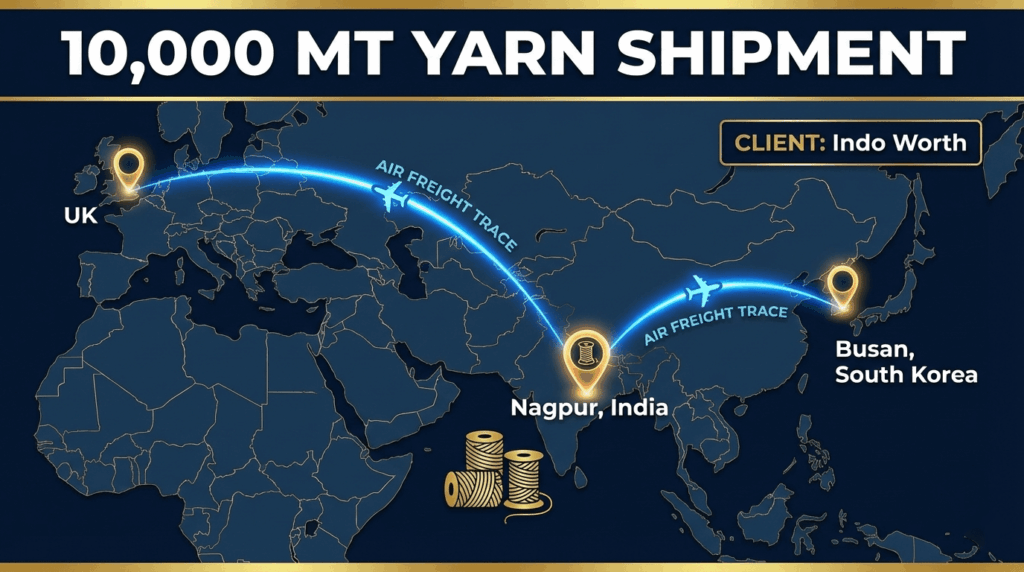
Textile logistics moves at the pace of demand. When fashion cycles shorten and production schedules tighten, delays are costly. US Enterprises was entrusted with a high-tempo assignment: transporting 10,000 metric tons of yarn from Nagpur to Busan and the United Kingdom using air freight.
This wasn’t a conventional export. Yarn is volume-heavy yet quality-sensitive, and choosing air transport meant one thing: speed had to come without compromise. The mission was to keep mills running overseas while preserving yarn integrity from origin to arrival.
Indo Worth operates within time-bound textile supply chains where delivery schedules are tightly aligned with downstream manufacturing. Missed timelines can disrupt dyeing, weaving, and finishing processes across borders.
They needed a logistics partner who understood that air freight for textiles isn’t about urgency alone, it’s about control, consistency, and coordination.
Moving 10,000 MT by air is uncommon for textiles. It required meticulous planning to balance aircraft capacity, frequency, and cost while meeting delivery windows.
Yarn must be protected from moisture, compression, and contamination. Improper packing or handling could compromise tensile strength and usability.
Shipments moved to Busan and the UK under different airline protocols, customs processes, and handling norms yet quality and timelines had to remain uniform.
Air freight schedules leave little room for error. Any documentation delay could push cargo to the next flight, impacting production cycles.
We broke down the total volume into flight-ready consignments, prioritizing urgency and destination requirements without overloading capacity.
Yarn was packed to withstand air cargo conditions protected against pressure, humidity, and movement during transit.
Our team worked closely with airline partners to secure consistent space, ensuring steady movement instead of last-minute scrambling.
All export paperwork, labeling, and compliance checks were completed well before cargo reached the airport, reducing the risk of rollovers.
From warehouse loading in Nagpur to airport handling, each shipment was monitored to maintain condition and timing.
Phase 1: Cargo planning and packaging design
Phase 2: Airline coordination and slot allocation
Phase 3: Airport handling and air freight execution
Phase 4: Delivery confirmation at Busan and UK
Each phase overlapped smoothly, allowing continuous movement without bottlenecks.
Total Cargo Moved: 10,000 MT of yarn
Origin: Nagpur
Destinations: Busan (Korea) and the UK
Transport Mode: Air freight
Quality Issues: None reported
Schedule Adherence: Maintained throughout
Despite the scale and speed required, shipments reached their destinations exactly as planned.
This operation showcased US Enterprises’ ability to handle textile logistics where time, volume, and quality intersect.
Airlifting yarn at this scale is not about urgency alone it’s about discipline. By successfully moving 10,000 MT of yarn from Nagpur to Busan and the UK, US Enterprises proved that textile logistics can be fast without being fragile.
For textile exporters who need speed without sacrificing quality, US Enterprises delivers logistics that keep production lines spinning on time, every time.