
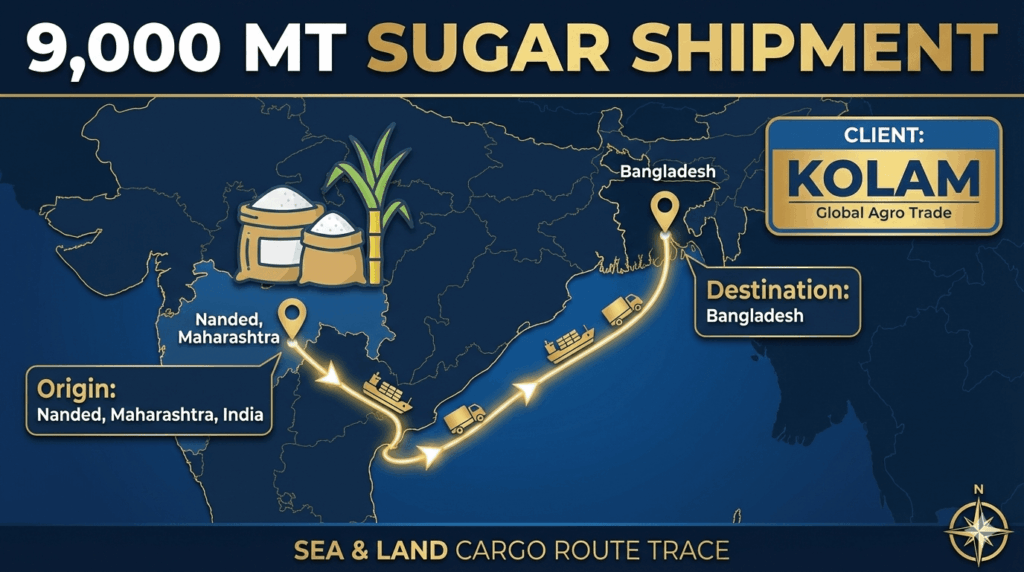
Moving agricultural cargo may sound straightforward, but anyone in the export business knows that bulk commodities come with their own set of pressures. When US Enterprises was entrusted with transporting 9,000 metric tons of sugar from Nanded to Bangladesh, the task went far beyond booking a vessel and moving bags from point A to point B.
Sugar is sensitive cargo. It reacts to moisture, handling conditions, and delays. One small mistake can affect quality, pricing, and buyer trust. Our goal was simple but demanding: move the shipment safely, keep the quality intact, and deliver right on time.
KOLAM is actively involved in agricultural trade and depends on consistent, delay-free exports to maintain market commitments. They needed a logistics partner who understands the realities of agri-commodity movement and can manage both operational and regulatory challenges without disruption.
For them, reliability wasn’t a bonus, it was non-negotiable.
Unlike general cargo, sugar needs dry storage, careful stacking, and quick movement at ports. Exposure to humidity or rough handling could easily lead to spoilage or weight loss.
Agricultural exports involve multiple checks, quality documentation, and customs coordination. Even a minor paperwork error can hold cargo at port.
Commodity exports work on fixed contracts. Any delay affects not just delivery but also pricing and future business relationships.
Smooth loading was critical. Longer port stays increase the risk of contamination and additional costs.
We mapped the entire movement in advance, from dispatch at Nanded to port handling and vessel loading. This helped us control exposure time and avoid unnecessary storage.
Vessel selection and sailing schedules were aligned with export timelines to ensure the cargo moved out without delay.
Our team handled export paperwork well in advance, coordinating inspections and approvals before the cargo reached the port. This eliminated last-minute surprises.
During loading, our operations team monitored handling closely to ensure the sugar remained protected and properly secured.
Initial Phase: Planning, documentation, and coordination
Mid Phase: Port movement and vessel loading
Final Phase: Sea transit and delivery confirmation
Each step flowed into the next without bottlenecks.
Total Cargo Moved: 9,000 MT
Destination Reached: Bangladesh
Quality Issues: None reported
Clearance Delays: Zero
Delivery: As scheduled
The shipment reached its destination in good condition, meeting both quality expectations and delivery timelines.
This movement reinforced US Enterprises’ strength in agricultural logistics. It showed that even high-volume commodity cargo needs planning, attention, and experience to move smoothly.
Strong control over bulk agri-exports
Reliable sea freight coordination
Accurate compliance handling
Consistent delivery performance
Bulk sugar exports may not look complex on paper, but execution is where things get real. By successfully moving 9,000 MT of sugar to Bangladesh, US Enterprises proved that careful planning and hands-on execution make all the difference.
If your agricultural exports depend on timing, quality, and trust, US Enterprises are built to carry that responsibility shipment after shipment.