
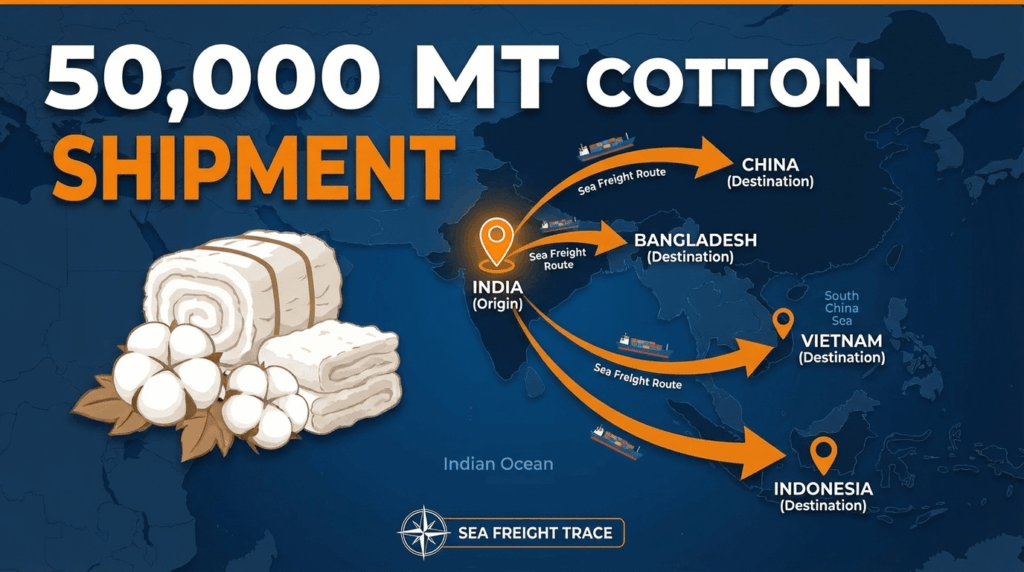
Cotton may be a natural product, but moving it at scale is anything but simple. When US Enterprises was assigned the responsibility of exporting 50,000 metric tons of cotton from various sourcing locations across India to China, Bangladesh, Vietnam, and Indonesia, it quickly became clear that this was not a single shipment, it was a multi-market coordination challenge.
Cotton is sensitive to moisture, handling conditions, and transit delays. Add multiple origins, multiple buyers, and multiple international routes, and the operation demands tight control at every step. Our role was to ensure that quality, timelines, and trust moved together.
This project involved multiple agricultural exporters and trading houses, each with their own delivery schedules, quality expectations, and destination requirements. While the product was the same, every client’s priority was different, some focused on speed, others on cost efficiency, and many on maintaining cotton grade integrity.
US Enterprises was brought in to unify these moving parts into one reliable logistics framework.
Cotton was sourced from different locations, each with its own dispatch readiness and storage conditions. Aligning pickups and port movements without congestion was critical.
Cotton bales are vulnerable to humidity, contamination, and rough handling. Any lapse could result in rejected cargo or price penalties at destination.
Exports to China, Bangladesh, Vietnam, and Indonesia meant navigating different documentation standards, inspection norms, and port regulations simultaneously.
Handling 50,000 MT over multiple sailings required careful vessel planning to avoid bottlenecks and unnecessary dwell time.
We created a central coordination plan while managing each origin independently. This ensured steady cargo flow without overwhelming ports or storage facilities.
Vessels were allocated based on destination demand and shipment readiness, allowing smooth distribution across routes without last-minute reshuffling.
Our team handled export paperwork and inspections in advance, aligning shipment documents with destination-specific requirements to avoid clearance issues.
From warehouse loading to port handling, cotton bales were monitored closely to minimize exposure to moisture and physical damage.
Stage 1: Origin coordination and cargo readiness
Stage 2: Port movement and documentation clearance
Stage 3: Sea freight execution across multiple routes
Stage 4: Delivery confirmation and shipment closure
Each stage overlapped carefully to maintain momentum and consistency
Total Cargo Moved: 0,000 MT5
Destination Reached: China, Bangladesh, Vietnam, Indonesia
Quality Issues: None reported
Clearance Delays: Zero major disruptions
Delivery: On schedule across routes
Despite the scale and complexity, shipments reached their destinations smoothly and as planned.
This operation reinforced US Enterprises’ strength in handling high-volume agricultural exports across diverse markets.
Cotton exports at this scale demand more than transport; they require coordination, care, and consistency. By successfully moving 50,000 MT of cotton across four international markets, US Enterprises demonstrated its ability to manage agricultural logistics without compromising on quality or timelines.
For exporters dealing with volume, variety, and international buyers, US Enterprises delivers logistics that stay steady no matter how many routes the shipment takes.